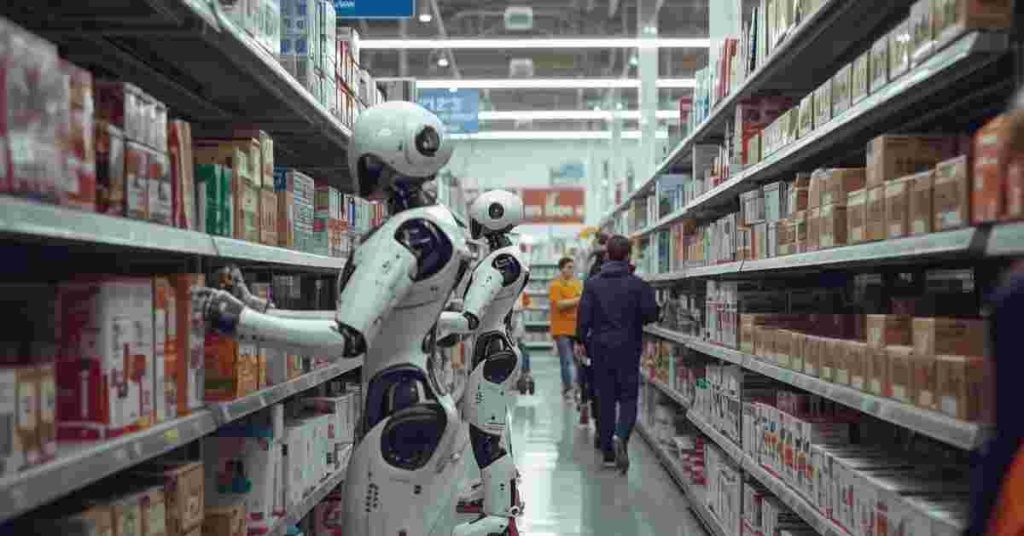
In the high-stakes world of retail, where margins are razor-thin and customer demands relentless, a quiet revolution is reshaping store floors. Major chains like Walmart, Amazon’s Whole Foods, and Target are rolling out robot stockers at scale, machines that zip through aisles restocking shelves overnight and during off-peak hours. Early data from these deployments points to labor cost reductions of up to 30 percent in targeted stores, a figure that has executives buzzing and unions raising alarms. This shift is not mere automation hype; it’s a calculated response to post-pandemic labor shortages, rising wages, and eCommerce pressures that demand flawless in-store execution.
Walmart led the charge last month, announcing expansions of its Alphabet-enabled robot fleet across 30 more U.S. supercenters. These autonomous units, developed in partnership with Google DeepMind, navigate warehouses and sales floors with laser precision, handling repetitive tasks like shelf replenishment and inventory checks. “We’re seeing productivity gains that free associates for higher-value customer interactions,” Walmart’s Chief Technology Officer, Suresh Kumar, said in a recent earnings call. Target followed suit, integrating Symbotic’s AI-driven robots into 20 distribution centers, while Kroger tests similar tech from Ocado in its Ohio stores. The common thread? A laser focus on slashing the biggest line item in operations: labor.
This move comes at a pivotal moment. U.S. retail labor costs have surged 25 percent since 2020, per Bureau of Labor Statistics data, driven by minimum wage hikes in 20 states and chronic understaffing. Turnover rates in grocery and big-box retail hover at 60 percent annually, far above the national average of 47 percent, according to payroll firm UKG. Robots address this head-on. In Walmart’s pilot stores, human stockers’ hours dropped by 40 percent without output loss, yielding that headline 30 percent cost savings. Analysts at McKinsey estimate such automation could save the U.S. grocery sector $20 billion yearly by 2030 if scaled nationwide.
The Technology Powering the Shift
At the heart of this trend are autonomous mobile robots (AMRs) equipped with advanced sensors, machine learning, and collaborative intelligence. Unlike rigid industrial arms confined to factories, these stockers are designed for dynamic retail environments. Walmart’s bots, for instance, use LiDAR scanners and computer vision to detect shelf gaps, grab items from conveyor feeds, and place them with sub-inch accuracy. They operate 24/7, coordinating via cloud-based swarm intelligence to avoid collisions and optimize routes.
Take Symbotic’s system at Target: it processes up to 1,000 cases per hour per robot, a 4x speedup over manual labor. Pricing starts at $500,000 per unit for a full deployment, but payback periods run 18 to 24 months through labor offsets. A 2025 Forrester report pegs average ROI at 35 percent for early adopters, factoring in reduced shrinkage from better inventory control. Shrinkage, retail’s polite term for theft and spoilage, costs the industry $112 billion annually, per National Retail Federation figures; robots cut this by 15 percent in trials by maintaining tighter stock levels.
Not all deployments are seamless. Initial setups demand warehouse redesigns, costing $2-5 million per site. Software glitches have caused temporary halts, as seen in Amazon’s 2024 Fresh store pilots where bots occasionally misidentified perishables. Yet, iteration is rapid. “We’ve refined pathfinding algorithms to handle Black Friday crowds,” noted a Symbotic spokesperson. Global players like Alibaba’s Freshippo in China already boast 70 percent automation in micro-fulfillment centers, restocking in under two hours via robot swarms.
Economic Impacts: Winners, Losers, and Broader Ripples
For retailers, the math is compelling. Labor comprises 10-15 percent of operating expenses in brick-and-mortar chains, per Deloitte. A 30 percent cut translates to $3-5 billion in annual savings for a giant like Walmart, which employs 1.6 million in the U.S. alone. This windfall funds price cuts or eCommerce investments, helping giants claw back share from online pure-plays. Walmart’s online sales jumped 21 percent last quarter, partly crediting in-store efficiency.
Smaller operators face a steeper climb. Independent grocers, lacking capital for $1 million robot suites, risk competitive disadvantage. “Scale matters here,” says retail consultant Neil Saunders of GlobalData. “Mom-and-pop shops can’t match these efficiencies, potentially accelerating consolidation.” U.S. independent grocery numbers have fallen 20 percent since 2015, and automation could hasten that to 30 percent by 2030.
Workers bear the brunt. Entry-level stockers, earning $15-18 hourly, face displacement. The National Retail Federation projects 2.4 million U.S. retail jobs at risk from automation by 2028, with stockers hit hardest. Unions like the United Food and Commercial Workers have protested, citing Walmart’s 2023 pilots where 500 roles shifted to oversight duties at lower pay. Retraining programs exist, Walmart’s reskilling 450,000 associates since 2020, but uptake lags at 60 percent. Wages for remaining roles rise modestly, to $20/hour on average, softening the blow.
Economically, it’s a mixed bag. Productivity gains could boost GDP by 0.5 percent in retail-heavy sectors, per Oxford Economics models. Consumers benefit from lower prices: Walmart attributes 2-3 percent shelf price drops to robot efficiencies. Yet, job losses exacerbate inequality; displaced workers often lack skills for tech roles, widening the blue-collar divide.
| Retailer | Robot Partner | Deployment Scale (2026) | Reported Labor Savings | Key Metric |
| Walmart | Alphabet (DeepMind) | 100+ stores | 30% in pilots | 40% fewer stocker hours |
| Target | Symbotic | 20 distribution centers | 25-28% | 4x case handling speed |
| Kroger | Ocado | 10 stores (testing) | 28% projected | 15% shrinkage reduction |
| Amazon (Whole Foods) | Agility Robotics | 15 locations | 32% | 24/7 operation |
| Alibaba (Freshippo) | Self-developed | 200+ centers | 40%+ | 2-hour restock cycle |
This table, compiled from company filings and industry reports, underscores the trend’s momentum.
Challenges and Roadblocks Ahead
Robots excel at repetition but falter in nuance. Delicate produce or custom displays still need human touch; current bots handle 80 percent of SKUs reliably, per Gartner. Regulatory hurdles loom too. California’s AB 1001 mandates impact studies for large-scale automation, potentially delaying expansions. Supply chain snarls for chips and batteries, exacerbated by U.S.-China tensions, have inflated robot costs 15 percent since 2024.
Safety incidents, though rare, draw scrutiny. A Target bot collision in Minnesota injured a worker last year, prompting OSHA reviews. Ethical questions swirl: should algorithms prioritize speed over caution? Data privacy arises as bots scan shelves, capturing shopper images for inventory mapping.
Internationally, adoption varies. Europe’s stringent labor laws slow uptake; Tesco trials in the UK yield only 20 percent savings due to union-mandated hybrid models. In Asia, speed rules: JD.com deploys robots in 500 stores, cutting costs 35 percent amid fierce competition.
Future Outlook: Hybrid Retail Dawns
Looking ahead, expect ubiquity. IDC forecasts 500,000 retail AMRs worldwide by 2030, up from 50,000 today, with AI enhancements like generative models predicting demand in real-time. Integration with AR glasses for human-robot teams will boost versatility, handling 95 percent of tasks.
Retailers must navigate this wisely. Forward-thinking chains invest in upskilling; Walmart’s model, blending bots with associate academies, sets a benchmark. Policymakers should eye universal basic services or wage subsidies to cushion transitions. For consumers, the upside is clear: fresher stock, lower prices, and frictionless shopping.
This robot incursion signals retail’s next epoch, where efficiency trumps tradition. Giants betting big stand to redefine profitability; laggards risk obsolescence.
Balancing Efficiency with Equity
Retail giants’ robot stockers promise transformative savings, with 30 percent labor cuts already materializing in pilots. Yet, success hinges on equitable implementation. By pairing automation with robust retraining and inclusive policies, the industry can harness these tools without deepening divides. As deployments accelerate, the real test will be whether cost wins translate to shared prosperity. In eCommerce’s brutal arena, adaptation is survival, but humanity must remain the core metric.