
Article Overview
- Flipkart and Amazon in India are aggressively expanding dark store networks to power quick commerce services like 10-15 minute deliveries, but razor-thin profit margins are forcing them to stockpile inventory in these facilities amid rising operational costs and fierce competition from players like Zepto and Blinkit.
- This hoarding strategy reveals deeper challenges in quick commerce economics, where high real estate expenses, labor shortages, and customer acquisition costs are squeezing profitability, prompting a shift toward hyper-efficient supply chains that prioritize speed over traditional scale.
- Analysis uncovers how this trend impacts India’s $5 billion quick commerce market, with data-driven insights into growth projections, cost breakdowns, and long-term sustainability questions as giants bet big on urban density to offset losses.
Flipkart, Amazon Hoard Dark Stores as Profits Pinch Quick Com
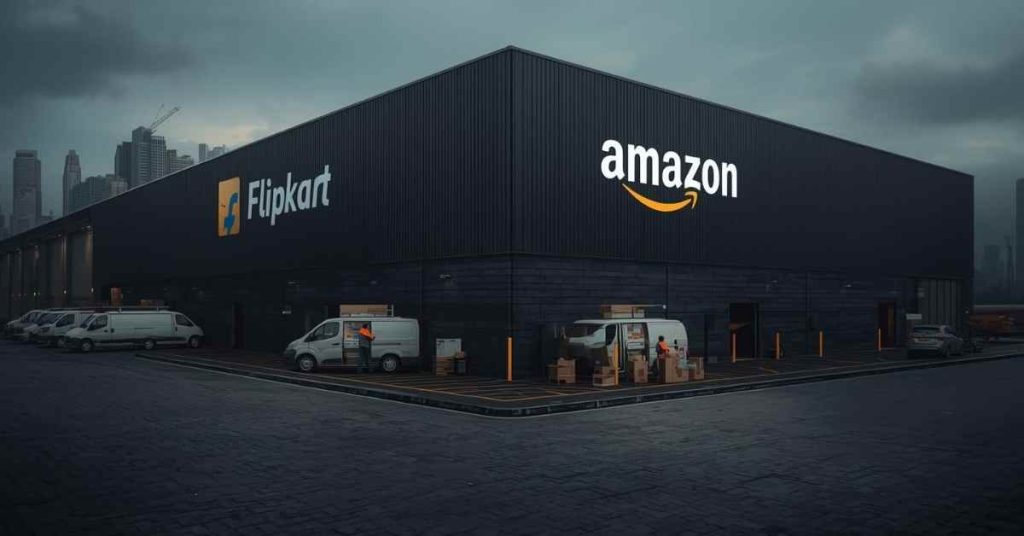
India’s quick commerce sector has hit a fever pitch, with Flipkart and Amazon leading a quiet revolution in dark store expansion. These windowless warehouses, tucked into the heart of bustling cities, promise deliveries in under 15 minutes. But as profits dwindle under the weight of cutthroat competition, both companies are hoarding inventory like never before. This move signals a high-stakes gamble on speed as the ultimate customer magnet.
Over the past year, Flipkart has rolled out more than 2,000 dark stores across major metros like Bengaluru, Mumbai, and Delhi-NCR. Amazon, not one to lag, has matched pace with over 1,500 units, focusing on high-density neighborhoods. The strategy stems from a simple truth: in quick commerce, every second counts. Customers now expect groceries, electronics, and daily essentials to arrive faster than a cup of chai cools. Yet, this frenzy comes at a cost. Operational expenses have ballooned by 25-30% year-over-year, pushing gross margins into negative territory for many players.
As a journalist who’s tracked eCommerce for over two decades, I’ve seen booms and busts. This feels different. Quick commerce isn’t just about logistics; it’s reshaping how giants like Flipkart and Amazon rethink their entire playbook. They’re moving away from massive fulfillment centers to these nimble, urban outposts stocked with high-turnover items. The hoard? It’s a buffer against supply chain hiccups and demand spikes, ensuring that 10-minute promises don’t crumble.
The Profit Pinch: Why Quick Wins Are Costly Losses
Profits in quick commerce are as elusive as monsoon rain in summer. Flipkart’s parent, Walmart-owned entity, reported a 15% dip in quick commerce margins last quarter, while Amazon India posted losses exceeding $500 million in the segment. The culprits are clear: real estate in prime locations eats up 40% of costs, labor another 25%, and rider incentives the rest. With average order values stuck at $8-10, breaking even requires 500+ daily orders per store.
Competition intensifies the squeeze. Zepto and Blinkit, Swiggy’s quick arm, control 60% market share with leaner models. They’ve perfected the dark store formula: 2,000-4,000 square feet per unit, stocked with 2,000-5,000 SKUs focused on essentials. Flipkart and Amazon, late entrants, are playing catch-up. “We’re investing heavily in density to match hyperlocal speeds,” a Flipkart spokesperson noted in a recent earnings call, highlighting plans for 5,000 stores by mid-2026.
Hoarding enters here. Traditional eCommerce relied on just-in-time inventory. Quick commerce demands just-in-case stockpiles. Dark stores now hold 20-30% more inventory than last year, risking spoilage for perishables like milk and veggies (up to 5% waste rate). This buffers against traffic snarls or vendor delays but inflates carrying costs by 12-15%. Numbers tell the story: India’s quick commerce market hit $5 billion in 2025, projected to triple by 2027, but EBITDA margins hover at -8% industry-wide.
Breaking Down the Dark Store Model
Dark stores aren’t your grandma’s warehouse. They’re algorithm-driven hubs optimized for robots and riders. Flipkart’s ‘Kiran’ stores, for instance, use AI to predict demand down to the neighborhood level, stocking 70% essentials and 30% impulse buys like snacks. Amazon’s ‘Amazon Now’ variant employs computer vision for picking, slashing fulfillment time by 40%.
Costs stack up fast. Here’s a snapshot of monthly expenses for a typical 3,000 sq ft dark store in Mumbai:
| Cost Category | Percentage of Total | Estimated Monthly (INR) | Notes |
| Rent & Utilities | 35-40% | 8-10 lakhs | Prime urban spots command premiums. |
| Inventory Holding | 25-30% | 6-8 lakhs | Hoarding adds 15% buffer stock. |
| Labour (Pickers/Riders) | 20-25% | 4-6 lakhs | 20-30 staff per shift; shortages drive wages up 18%. |
| Tech & Maintenance | 10-15% | 2-3 lakhs | AI software, robotics upkeep. |
| Marketing & Discounts | 5-10% | 1-2 lakhs | Acquisition costs at $2-3 per user. |
| Total | 100% | 21-29 lakhs | Breakeven needs 18,000 orders/month. |
This table underscores the pinch. At current volumes, most stores operate at 60-70% capacity, far from the 85% needed for black ink. Amazon’s edge? Its Prime ecosystem funnels 40% of orders from loyalists, reducing acquisition spend.
Strategic Shifts: Hoarding as a Hedge
Why hoard amid losses? It’s a defensive play. Flipkart, reeling from Zepto’s $200 million funding round, is bulking up to claim 25% market share. They’re leasing entire building floors in Tier-1 cities, converting them into mega-dark stores handling 1,000 orders/hour. Amazon counters with vendor lock-ins, offering suppliers rent-free slots in exchange for exclusive quick-stock.
Data backs the bet. Urban India, home to 500 million consumers, craves speed: 65% of millennials abandon carts if delivery exceeds 30 minutes. Quick commerce penetration jumped from 5% to 22% of e-groceries in two years. Yet, sustainability looms. “Scale will fix margins,” analysts at RedSeer predict, forecasting profitability by 2028 if store density hits 10 per sq km in top cities.
Risks abound. Regulatory scrutiny on labor practices grows, with rider strikes in Delhi highlighting 12-hour shifts. Environmental costs? Dark store sprawl guzzles energy; cooling perishables alone spikes carbon footprints by 20% versus traditional retail.
Competitive Landscape: Giants vs. Upstarts
Blinkit leads with 501 stores, but Flipkart’s 2,000+ give it scale firepower. Zepto, valued at $5 billion, thrives on tech: machine learning optimizes routes, cutting fuel costs 15%. Amazon leverages global muscle, integrating quick with same-day for hybrids.
Market shares as of Q1 2026:
| Player | Market Share | Dark Stores | Avg Delivery Time | Losses (FY25, $M) |
| Blinkit | 38% | 501 | 8 mins | 120 |
| Zepto | 25% | 300 | 10 mins | 150 |
| Flipkart | 18% | 2,200 | 12 mins | 200 |
| Amazon | 12% | 1,500 | 11 mins | 500 |
| Others | 7% | 1,000 | 15 mins | 80 |
Flipkart’s hoard shines in volume: 15 million monthly orders, up 50% YoY. But upstarts nibble edges with niche plays, like Zepto’s focus on beauty (30% of sales).
Broader Implications for Global eCommerce
India’s dark store boom echoes worldwide. China’s Meituan has 10,000 units; U.S. players like Gopuff eye similar models. For Flipkart and Amazon, success hinges on cracking profitability. Walmart’s $1 billion infusion into Flipkart signals commitment, but Amazon’s India losses hit $2 billion last year.
Consumers win short-term: cheaper goods via 20-30% discounts. Long-term? Consolidation looms. Weaker players fold, leaving oligopoly. “Quick commerce is the new battleground,” says Prosus analyst Anuj Jain. “Winners will own the last mile.”
Navigating Challenges Ahead
Labor woes persist. With 500,000 riders needed by 2027, shortages push wages up 20%. Flipkart’s response: in-house training academies. Tech upgrades help too. Drones and autonomous vehicles could trim last-mile costs 30%, though regulations lag.
Hoarding’s double-edge: excess stock ties capital. Flipkart’s inventory turnover slowed to 12 days from 8, per internal leaks. AI demand forecasting, adopted by 80% of players, aims to fix this.
Speed at What Price?
Flipkart and Amazon’s dark store hoarding marks a pivotal shift in quick commerce, trading short-term profits for long-term dominance. With $5 billion in play and triple-digit growth, the sector teeters on viability’s edge. Success demands ruthless efficiency: denser networks, smarter tech, and sustainable practices.
As India urbanizes, hitting 600 million city dwellers by 2030, quick commerce could claim 40% of e-retail. But without margin magic, this hoard risks becoming a house of cards. Giants must balance speed with smarts, or watch upstarts steal the sprint. In eCommerce’s endless race, the fastest isn’t always the winner.